
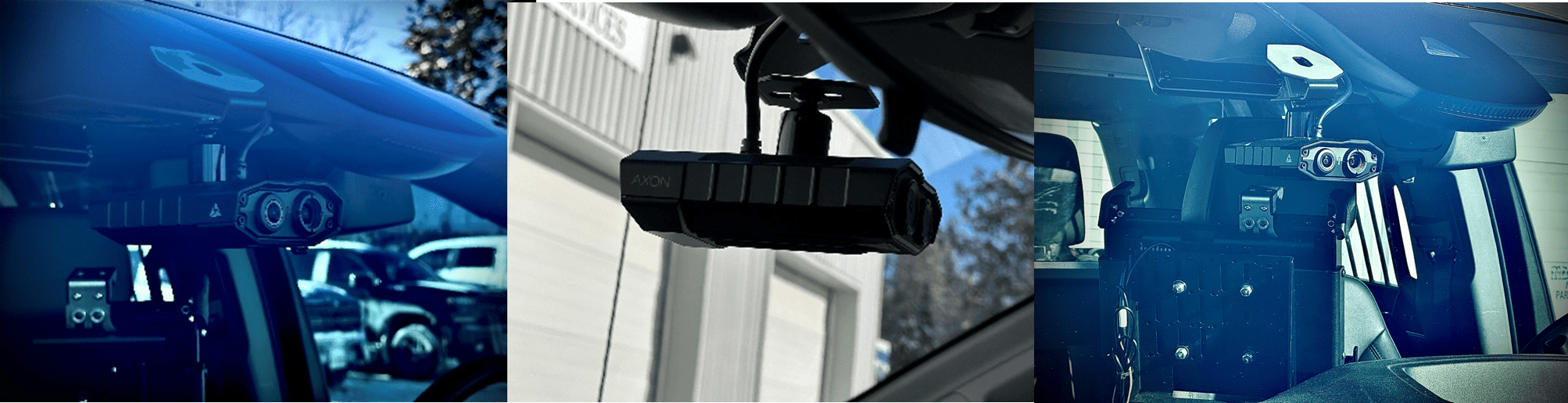
UCCM APS has joined other police services across Ontario in equipping all patrol vehicles with Mobile Automated Licence Plate Recognition (ALPR) cameras. These systems use integrated cameras and software to automatically scan licence plates and alert officers to stolen plates, suspended drivers, and vehicles linked to missing or wanted individuals. They can also flag vehicles connected to AMBER Alerts. In addition, this technology functions as a full in‑car camera system, similar to an advanced dash cam.
The UCCM Anishnaabe Police uses Automated Licence Plate Recognition (ALPR) cameras to automatically scan and detect licence plates in the surrounding area of a police cruiser. This makes it more difficult for suspended drivers, drivers of stolen cars, and other vehicles with plates in poor standing to drive undetected. Under optimal conditions, the ALPR system is capable of scanning thousands of licence plates per hour.
A camera is mounted on the windshield of a police cruiser. The camera points forward and scans cars in front of the police vehicle.
The licence plate scanner continuously scans licence plates as an officer drives around the communities. The officer is notified when there is a “hit” and will take the appropriate enforcement action. For example, if the hit indicated a licence plate was owned by a suspended driver, the officer would stop the vehicle to determine if the driver of the vehicle was that person.
The ALPR system has access to an Ontario Ministry of Transportation and Canadian Police Information Centre “hot list”, which is a data base that contains millions of licence plates in poor standing. If the ALPR camera scans a licence plate that is registered to the hot list, it produces a hit, alerting the officers on a monitor in the cruiser that the plate is in poor standing.
Licence plates that are in poor standing can fall into one or more of the following categories:
- Stolen vehicles or licence plates
- Missing or expired licence plates
- Licence plates registered to unlicenced, uninsured, prohibited or suspended drivers
Licence plates associated to persons with outstanding Canada-wide warrants or who are reported missing
If your licence plate is a non-hit, the officer will not even be notified that your plate was scanned. All information related to a non-hit is deleted.
If your license plate is a hit, the officer will receive a notification of the hit and will receive basic information about the vehicle and the registered owner such as the make, model and colour of the vehicle, and the name, gender and date of birth of the owner.
The officer must then stop the vehicle and verify all information within the hit before taking any enforcement action. Hit information is retained in accordance with the Freedom of Information and Protection of Privacy Act, R.S.O. 1990, c. F.31 | ontario.ca
The scanner is part of the police cruiser’s in-car video system.
Privacy
The Information and Privacy Commissioner of Ontario (IPC) has released guidelines on the use of ALPRS by police services. The report ensures that the Police Service’s use of this technology respects privacy rights recognized under the Canadian Charter of Rights and Freedoms, and that personal information is handled in a lawful manner.
Our collection, retention, use and disclosure of any personal information obtained from the ALPR program is done so in compliance with the Freedom of Information and Protection of Privacy Act, R.S.O. 1990, c. F.31 | ontario.ca
Questions?
If you have any questions or concerns related to this technology, please call 705-377-7135.